


The line between communications and revenue isn’t dotted anymore. Here’s what the research actually shows — and why it matters.
Every business owner wants to know the same thing when they’re staring at a marketing or communications investment. What do I get? What is this actually worth?
For years, the honest answer was frustrating: it depends.
It depends on positioning. It depends on market timing. It depends on how fast you can get content through your internal review process and out the door. The line between communications effort and revenue outcome was faint. Drawn in pencil. Hard to defend in a budget meeting.
That line is becoming solid. And there’s data behind it now.
What McKinsey Found in 2020 (And Why It’s Probably Worse Now)
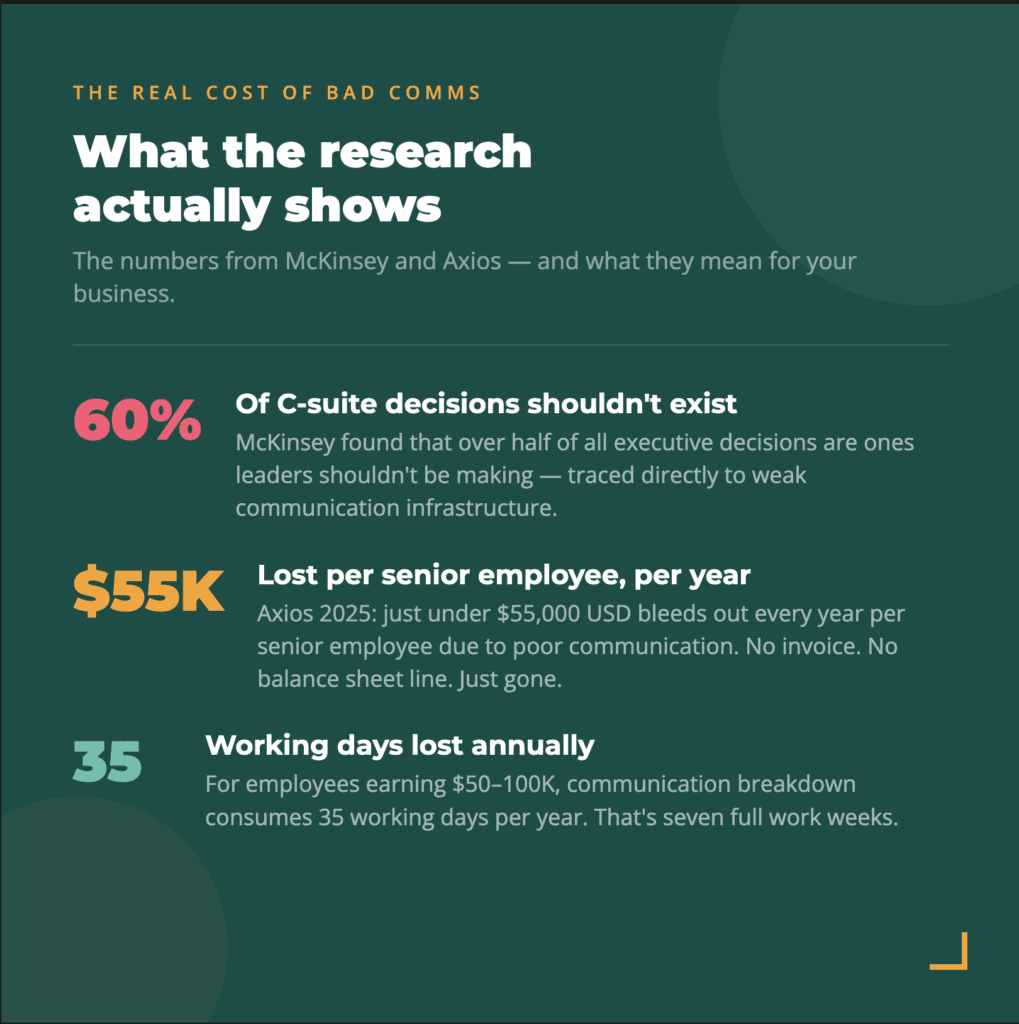
McKinsey studied executive decision-making and found that senior leaders were spending roughly 40% of their week on decisions. That alone isn’t surprising. What is surprising — and should be genuinely alarming — is this: 60% of those decisions were ones those leaders shouldn’t have been making at all.
They traced it back directly to a lack of communication infrastructure.
Do the math with me. If an executive spends 40% of their week on decisions, and 60% of those decisions are unnecessary, that’s 24% of their week consumed by a communications problem. Fix even half of it and you’ve given your senior leadership team back 12% of their time, every single week. That’s not a soft benefit. That’s a real number you can put a dollar figure on — because you know what that time costs.
The Axios Number That Will Stick With You
In 2025, Axios put a finer point on it. Their research pegged the cost of ineffective communication at just under $55,000 USD per senior employee, per year.
Per year. Per person.
Multiply that across your leadership team. Multiply it across your senior contributors. That number doesn’t show up as a line item in your annual report. There’s no invoice. No tax bill. It just bleeds out — slowly, consistently — through missed decisions, delayed launches, confused audiences, and work that ships before it’s ready because nobody was sure who was supposed to sign off.
Axios also found that 48% of C-suite leaders reported getting pulled deeper into projects than they should have been, simply because communication wasn’t clear enough downstream for anyone else to move without them.
That’s the bottleneck. And it’s not a personality problem. It’s a structural one.
The Upstream Problem Nobody Wants to Solve
Here’s what I’ve seen happen time and again with clients. They feel a pain point — launches underperforming, media pitches going nowhere, content going out that feels off-brand. And they come in asking for the downstream fix. More press releases. Better ad campaigns. A new social strategy.
I had a client last year who asked me to build better launch campaigns for six different service products because sales were down across the board. I could have done that. And they would have gotten the same results.
Because the problem wasn’t the campaigns. It was that product positioning decisions were being made on the fly. Content was getting shipped without proper brand review. Interns were being handed big decisions that nobody had briefed them on. Two of those six products were actually duds that should have been pulled months ago.
Once we went back upstream — built better structure, created clear briefs, got the right people reviewing the right things — a few things happened. They dropped two products, focused on four, set up a proper communications infrastructure for each one, and started selling the same amount of revenue with less product and less chaos.
Another client thought they had an earned media problem. No journalist interest, no pickup, no traction. What they actually had was an upstream story problem. Their pitch was: we exist and we’re great. That’s not a pitch. That’s a first draft that never got edited. The earned media failure was just a symptom.
You can’t fix a downstream symptom without addressing what’s causing it three steps back.
Why This Matters Right Now
The role of communications in business is shifting. For years, the Chief Communications Officer was C-suite in title but VP in function. They weren’t always at the table when the CEO, CFO, and COO were making the decisions that would eventually land in their lap to execute.
That’s changing. Companies that are moving fast and winning in this current environment are the ones who have brought communications into lockstep with operations. The CCO is moving up to the same tier as the COO — because faster, clearer communication means faster, better decisions, and faster decisions mean more revenue.
This isn’t a soft insight. It’s an operational efficiency argument. And the data now backs it up.
So Where’s Your Leak?
The goal isn’t to present you with a $55,000 figure and tell you to panic. The goal is to help you figure out where your specific version of that leak is — because it looks different in every organization.
Sometimes it’s the CEO spending two hours a day on decisions a well-briefed team could have made. Sometimes it’s content sitting in review for three weeks because nobody’s clear on who the final approver is. Sometimes it’s six products when four would do.
The first step is being willing to sit with the problem long enough to see it clearly. Not jump to the visible symptom. Not hire an intern to patch it. Go three steps upstream.
Because once you fix the right thing, everything downstream moves faster. And faster, in this environment, is the whole game.
Ways we can work together
Strategic Comms Coaching
Monthly coaching to strengthen your narrative positioning and strategy
Fractional Advisory
Full integration into your comms operations
Branded Podcasting
Strategic podcasts through my virtual production company Story Studio Network.
Executive Ghostwriting
On brand, on voice, authority building long form content creation such as articles or books

